

Table of Contents
The Rise and Fall of Al-Andalus
There was a time when there was a region in Europe where Muslim rulers reigned for 800 years. That era was not like today; today Europe leads the world, but at that time, all of Europe used to learn from just one sultanate. That region is also called the Golden Age of Islam. Yes, I am talking about Al-Andalus, which is modern-day Spain. It remained established under Muslim rule from around 711 to 1492. Al-Andalus was known for its extraordinary knowledge, beauty, architecture, innovation, and intellectual brilliance. While other European sultanates were struggling with limited education and instability, Al-Andalus was a beacon of light shining in Europe. The scholars, libraries, and scientific progress of Al-Andalus were famous throughout the world, and people came from different corners of the globe to Al-Andalus to acquire knowledge. So, today in this article, we are going to talk about the rise of Al-Andalus and the Golden Age of Islam. Then, we will talk about the unfortunate fall of the great Al-Andalus.
The Beginning
Let’s start from the beginning. We will understand this long story in short so that you can learn everything about Al-Andalus through a brief narrative. It begins in 711 CE with an unexpected mission led by Tariq ibn Ziyad, who was a commander of the Umayyad Dynasty and was born in North Africa (Wadi Tafna), which is in modern-day Algeria. He went from North Africa to Spain with his army of 7,000 soldiers. They crossed through the Strait of Gibraltar, which is a narrow channel between Africa and Europe that connects the Atlantic Ocean to the Mediterranean Sea. Even though Tariq ibn Ziyad had an army of only 7,000 soldiers, he faced the Visigothic King: King Roderic. Despite the odds, Tariq ibn Ziyad’s army defeated King Roderic’s army and achieved victory, after which the doors of Spain opened for the Muslim army. This marked the start of a great rule. After a few years, most of the Iberian Peninsula came under Muslim control. This victory was a massive beginning that later transformed into the Golden Age of Islam. It was the start of a new civilization in Europe.
The Foundation of Al-Andalus
After the conquest of Spain, it became part of the Umayyad Caliphate. However, a major turning point came with the reign of Abd al-Rahman I. He was a survivor of the Umayyad Dynasty, which had been overthrown in the East, after which he escaped to Spain. He established an independent Muslim state and laid the foundations of a powerful and lasting civilization. He established the city of Cordoba as the capital. This was the start of Al-Andalus, and from here, Al-Andalus began to grow—not just politically, but intellectually and culturally.
The Golden Age: When Al-Andalus Led The World
Al-Andalus was at its peak during the reign of Abd al-Rahman III. In his time, Al-Andalus was one of the most advanced societies. Cordoba became the greatest intellectual center in history. It is said that the library of Al-Andalus had more than 400,000 books. At that time, while there was a lack of education and books across the rest of Europe, Al-Andalus possessed everything that other sultanates did not. Students came from far-off cities and different countries to Al-Andalus to acquire knowledge.
- Medicine
- Astronomy
- Science
- Mathematics
- Philosophy
Al-Andalus produced some of the greatest minds who are still known today, and whose studies or inventions are still used in today’s world:
- Ibn Rushd — whose works influenced European philosophy.
- Al-Zahrawi — a pioneer in medical science.
- Ibn Hazm — known for his writings in theology and literature.
Later on, their contributions were translated into Latin and other languages, which were then sent to other European countries. These were some of the greats of Al-Andalus, even though I have only given a small example. Otherwise, there were many people who brought about a change in the world by gaining knowledge from Al-Andalus. Cordoba was a very advanced and developed city in that era:
- Street lighting at night
- Paved roads
- Public baths
- Clean water systems
Even though these are very basic nowadays, at that time, all of this was very advanced, and it existed in Al-Andalus while other European countries lacked these facilities.
- Also Read: Why Did the Qiblah Change? Full Story of Kaaba Direction in Islam 2026
- Also Read: Muslims Migration to Abyssinia: The First Hijrah in Islam 613–615 CE Oppression Of Quraysh
- Also Read: Political Crisis After The Death Of Prophet Muhammad (PBUH) 2026
Muslims, Jews & Christians Living In Al-Andalus
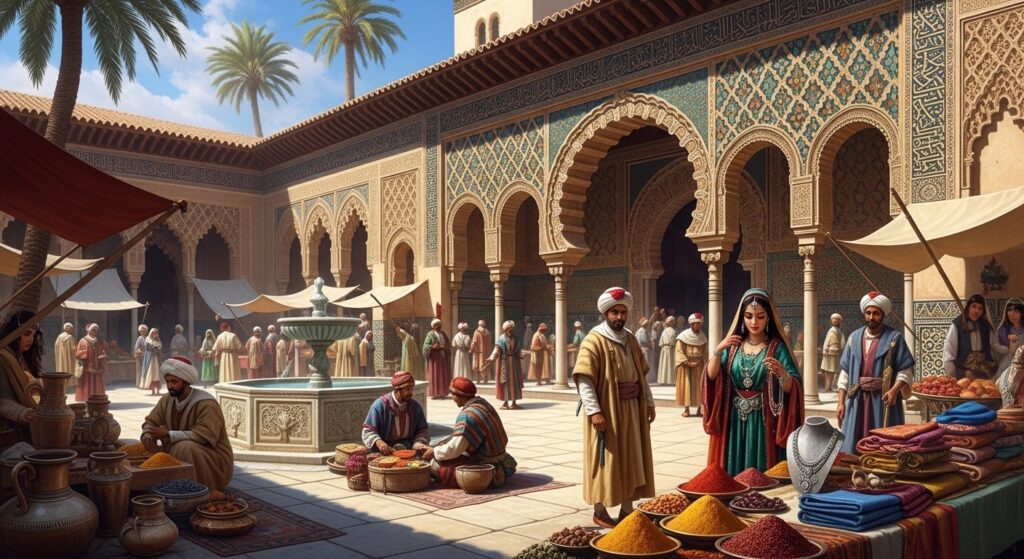
In Al-Andalus, Muslims, Jews, and Christians all lived together. While other European countries practiced discrimination, Al-Andalus was more tolerant in this matter, and everyone lived together without conflict. Everyone collaborated on intellectual and cultural contributions, which led to growth in the region. The exchange of ideas between them created a more dynamic society. It wasn’t like today, where we claim inventions based on religion—saying “this was a Christian invention” or “this was a Muslim invention.” Even though Al-Andalus was a Muslim-ruled country, religious freedom always existed. This was the result of Islamic teachings.
Beginning Of Decline
However, as strong leadership grew weak and began to fall—the same leadership that once brought everyone together—Al-Andalus began to divide. As leadership weakened and corrupt leaders took over, Al-Andalus gradually split. The region converted into small kingdoms called “Taifa states.” Not only were they divided, but they also began to compete with one another. While they needed to remain united to face external threats, unfortunately, they became weak internally.
The Reconquista
Gradually, these divisions became major, and religious conflicts arose. Christian kingdoms started growing stronger and began reclaiming the lands. This was not an instant process but took place over centuries through multiple campaigns known as the “Reconquista.” Major cities fell, such as:
- Toledo in 1085
- Cordoba in 1236
- Seville in 1248
All these major hubs gradually crumbled, and Muslim power slowly exited Spain. Multiple campaigns lasted for many years where Christians insisted on reclaiming the land. In the end, only one Muslim state remained:
- Granada
This city was ruled under Muslim authority for the next 200 years through diplomacy, tribute payments, and strategic alliances. This city housed the magnificent Alhambra Palace, which displayed the brilliant architecture of Al-Andalus. However, Granada could not survive for many more years.
Final Fall Of Muslim Rule In 1492
In 1492, the last Muslim state (Granada) was defeated, and Muslim rule over Spain ended entirely. The Catholic monarchs who conquered Granada were:
- Ferdinand II of Aragon
- Isabella I of Castile
This marked the end of Muslim rule. However, when this new Christian rule came to Spain, they made many promises to the Muslims regarding religious freedom. But these promises were broken very quickly. The treatment of Muslims and Jews by the Christians became harsh, and they faced injustice. Many Muslims were forcibly converted; if they did not convert, they were persecuted. During this period, Christian rulers issued many harsh policies targeting Muslims and Jews.
Why Did Al-Andalus Fall?
There are many reasons for the fall of Al-Andalus. It was not just one or two reasons:
- Weak leadership
- Internal division
- Love of luxury
- Loss of purpose
First comes weak leadership, because when strong leaders ruled, they kept everyone united. But weak leaders led to conflicts and internal divisions. When such things happen and a ruler sees his country being divided, he should take strict and quick actions. Secondly, there was the issue of luxury; due to the increase in wealth, many leaders and rulers gradually began to run away from their responsibilities. Once they found comfort, they became less involved in national affairs and more preoccupied with their own lives. As for the loss of purpose, a decline in spiritual and moral values contributed to political weakness.
Conclusion
We learn a lot from this event. As you have seen, that Golden Islamic period which lasted for 800 years turned into a disaster due to internal weakness and corrupt leadership. Al-Andalus, which was once a knowledge hub for other countries and cities with expert scholars in every subject, later turned into a land of war due to weak leadership and passed from Muslim rule to corrupt Christian rule. Following this, Muslims and Jews were subjected to forced conversions and persecution. We learn a great deal from this history. We learn that if there is no Unity, Knowledge, and Correct Leadership, no matter how big a sultanate is, it will not last. I have heard many stories of empires that lasted for centuries but crumbled due to corrupt leadership and a lack of internal unity, allowing external enemies to take advantage and occupy the land, making it even more corrupt. So, I hope you all learned something new today. Take care of yourself and your family. May Allah forgive all our sins and accept our supplications. Ameen.