

Table of Contents
How The Adhan Was Chosen In Islam
Every day across the world, one voice echoes that plays a huge role in the life of a Muslim. It is a voice that, when it resounds, Muslims all over the world pause their work and leave their homes, heading toward the mosque. Yes, I am talking about the Adhan (the Islamic call to prayer). In this article, we will talk about the Adhan, learn who gave the first Adhan in Islam, and understand how the Adhan was chosen in Islam. In other words, today we will learn about the event behind the selection of the Adhan. Did you know that during the time of Prophet Muhammad ﷺ, there was no proper system to gather people for prayer? Some companions gave a few recommendations, which we will discuss further ahead.
Early Days of Islam
If we go back to the early days of Islam, during the time in Madinah, the number of Muslims was gradually increasing, and many people were embracing Islam. People from different communities and religions were living together side by side. At that time, a problem arose that made the Muslim Ummah think deeply: how should Muslims be gathered at prayer time?
This problem may seem small, but it was not. Many companions suggested different methods, such as using a horn like the Jews or ringing a bell like the Christians. Some even suggested lighting a fire. However, Prophet Muhammad ﷺ did not like any of these suggestions. He wanted Islam to have its own unique method to gather Muslims—something different from others, something simple yet meaningful, not just a horn or a bell. He wanted a method that would be powerful.
Then, an extraordinary event took place—an event that astonished everyone, something no one had imagined.
Dream of Abdullah Ibn Zayd رضي الله عنه
One night, one of Prophet Muhammad ﷺ’s companions, Abdullah Ibn Zayd رضي الله عنه, had a dream in which he saw an angel holding a bell in his hand. Abdullah Ibn Zayd رضي الله عنه approached the angel and asked about the price of the bell, meaning he asked if the angel would sell it to him. This dream was directly related to the issue of gathering Muslims for prayer and was from Allah.
When Abdullah Ibn Zayd رضي الله عنه asked this, the angel replied:
“Shall I not teach you something better than this?”
Then the angel recited words that continue to echo to this day and will continue to do so forever. Those words were none other than the Adhan itself. The angel taught Abdullah Ibn Zayd رضي الله عنه the words of the Adhan.
This event clearly shows that the Adhan we hear today was neither the idea of any companion nor Prophet Muhammad ﷺ’s personal choice; rather, it was a direct command from Allah for Muslims to gather one another for worship through this call.
As soon as morning came and Abdullah Ibn Zayd رضي الله عنه woke up, he understood that this was a sign from Allah. He quickly went to Prophet Muhammad ﷺ and told him everything. The Prophet ﷺ listened carefully and confirmed that this was not an ordinary dream but a message from Allah.
Shortly afterward, another companion rushed to Prophet Muhammad ﷺ—this was Umar Ibn Al-Khattab رضي الله عنه. He also reported that he had experienced the same dream in which an angel recited the Adhan. This gave even greater authenticity and confirmation that this was no ordinary dream but indeed a command from Allah.
Also Read: Powerful Story: Khalid ibn Walid Biography: The Undefeated Sword of Allah (Sayfullah) 2026
Also Read: How Important Is Rajab? 7 Things About Rajab You Need To Know 2026.
Also Read: How To Pray Salah In Islam 2026: A Complete Step-by-Step Guide According To All Schools Of Thought
Also Read: Why Friday Is So Special in Islam – Full History & Importance 2026
First Adhan of Islam and Bilal Ibn Rabah رضي الله عنه
After hearing everything, Prophet Muhammad ﷺ sent for Bilal Ibn Rabah رضي الله عنه. The Prophet ﷺ instructed Abdullah Ibn Zayd رضي الله عنه to teach the Adhan to Bilal رضي الله عنه because Bilal had a beautiful, powerful, and clear voice.
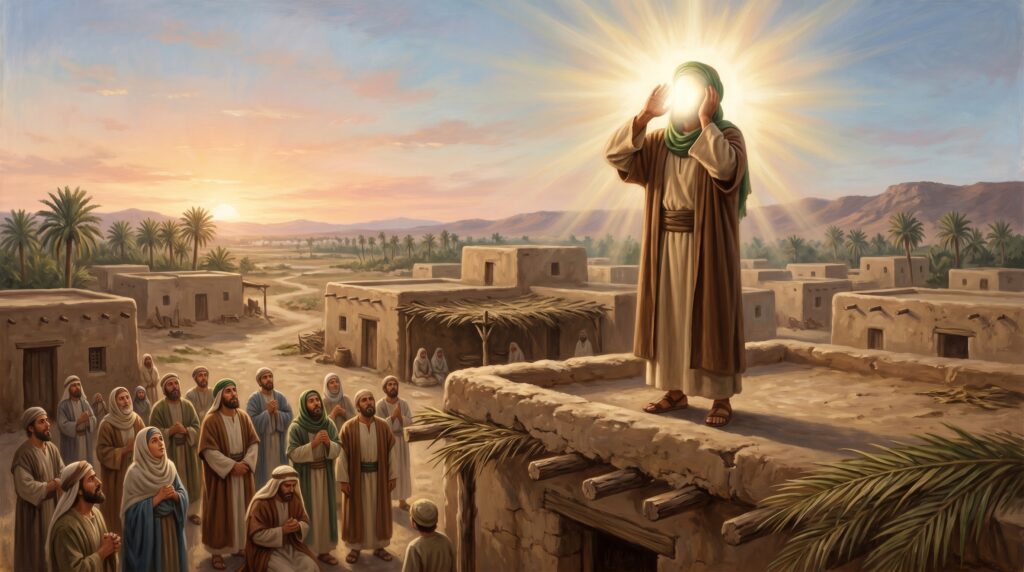
Abdullah Ibn Zayd رضي الله عنه taught Bilal Ibn Rabah رضي الله عنه the Adhan, after which Bilal رضي الله عنه climbed to a high place and recited the Adhan for the very first time:
Allāhu Akbar, Allāhu Akbar
Allāhu Akbar, Allāhu Akbar
Ashhadu an lā ilāha illa Allāh
Ashhadu an lā ilāha illa Allāh
Ashhadu anna Muḥammadan Rasūl Allāh
Ashhadu anna Muḥammadan Rasūl Allāh
Ḥayya ‘alaṣ-ṣalāh
Ḥayya ‘alaṣ-ṣalāh
Ḥayya ‘alal-falāḥ
Ḥayya ‘alal-falāḥ
Allāhu Akbar, Allāhu Akbar
Lā ilāha illa Allāh
This event took place in Madinah. The people of Madinah stood still and listened in amazement. They had never heard anything like it before. For the first time, this powerful declaration echoed:
- Allāhu Akbar (Allah is the Greatest)
- Ashhadu an lā ilāha illa Allāh (I bear witness that there is no god but Allah)
- Ashhadu anna Muḥammadan Rasūl Allāh (I bear witness that Muhammad ﷺ is the Messenger of Allah)
- Ḥayya ‘alaṣ-ṣalāh (Come to prayer)
- Ḥayya ‘alal-falāḥ (Come to success)
- Lā ilāha illa Allāh (There is no god but Allah)
And this is how the first Adhan in Islam was given.
Conclusion
I hope that today you learned the truth behind the Adhan. As you can see, the Adhan was not created by any companion or by Prophet Muhammad ﷺ himself, but rather it came directly from Allah for His servants.
There is something truly unique about the Adhan that is not found in other religions. Its greatest distinction is that it is not like a bell or horn, which carries no real meaning. Instead, Islam’s call to prayer uses the human voice and delivers a message filled with purpose and meaning. Rather than simply ringing a bell, it teaches people something meaningful and serves as a reminder.
This is a unique feature found only in Islam and not in other religions. The Adhan is not merely a call to prayer—it is a message and a reminder for Muslims.
That was it for today. We will meet again in our next article. Until then, take care of yourself and your family. May Allah forgive all our sins and accept our supplications. Ameen.