

السَّلاَمُ عَلَيْكُمْ وَرَحْمَةُ اللهِ وَبَرَكَاتُهُ
Political Crisis After The Death Of Prophet Muhammad (PBUH)
On the day of 12th Rabi al-Awwal, 11 AH, an event occurred that no one had ever imagined. This day struck all Muslims like a massive shock. It was a deeply emotional moment for the entire world, especially for the Ummah, when Prophet Muhammad ﷺ bid farewell to this world and returned to his Lord (The Death of the Prophet). For twenty-three years, he had been the leader who built love in people’s hearts and served them. He was the guide who managed the responsibilities of prophethood, leading through leadership, law, and mercy for his Ummah. He was no ordinary human; he was the Imam-ul-Anbiya (the leader of the prophets). The leader, the commander, the teacher, the father, the one who changed all of Arabia—and now the whole world. Above all, he was the Greatest Prophet of Allah. Suddenly, one day, he left this world.
In today’s article, we will learn about the state of Madinah when Prophet Muhammad ﷺ passed away. What was the reaction of the Sahaba رضي الله عنهم? You might think it wasn’t a major incident, but it was not as simple or easy as it seems. It was a massive trauma for the Ummah that their beloved Messenger was no longer with them.
THE MOMENTS BEFORE DEATH OF THE PROPHET
Before his death arrived, Prophet Muhammad ﷺ stayed at the house of his wife, Hazrat Aisha رضي الله عنها. Prophet Muhammad ﷺ knew that he did not have much time left. This is why, a few months before his death, on the 9th of Dhul Hijjah, 10 AH, he delivered his Last Sermon at Mount Arafat, Jabal ar-Rahman. There, he spoke of many things and gave much advice to the Ummah. In the speech, he mentioned many things, including women’s rights and equality. In that same sermon, he also said:
Perhaps I will not meet you again after this year.
As his condition became more serious and his time drew closer, he told his companions to take him to the room of Hazrat Aisha رضي الله عنها. It was there, in the lap of Hazrat Aisha رضي الله عنها, that he passed away. Before his death, his last words were:
With the highest companionship…
Hazrat Aisha رضي الله عنها narrated that she felt the body of Prophet Muhammad ﷺ becoming heavy. Thus, the greatest Prophet of Allah bid farewell to the world, leaving behind the Word of Allah (the Qur’an) and his Sunnah.
SHOCK IN MADINA
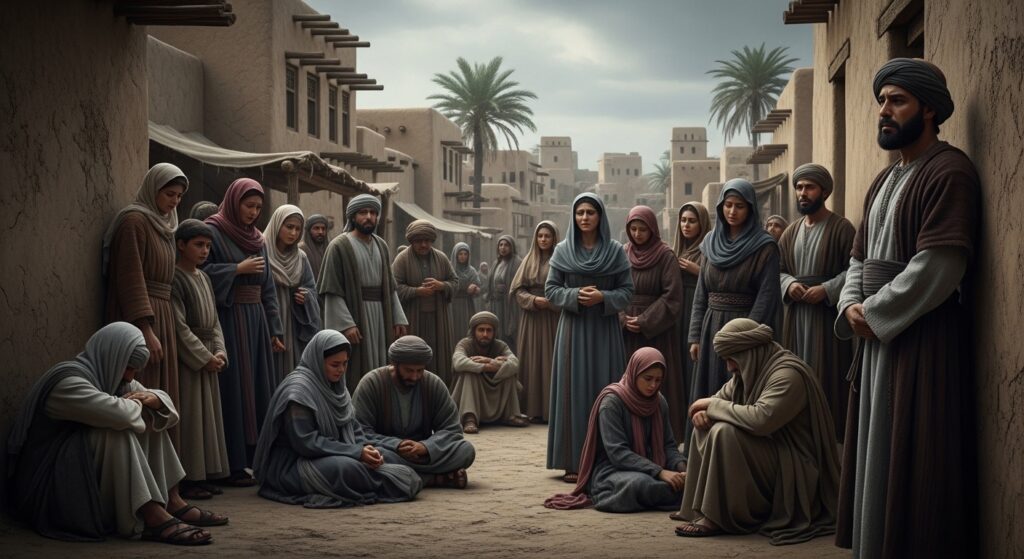
As soon as this news spread through Madinah, people received a massive shock. Everyone was in confusion; no one could believe that Prophet Muhammad ﷺ had passed away. Chaos began to spread everywhere in Madinah. Many Sahaba رضي الله عنهم were not convinced by this news. Among them was Hazrat Umar ibn al-Khattab رضي الله عنه, who absolutely did not believe it upon hearing it. He said:
Whoever says Muhammad has died, I will strike his neck! He has not died. He has gone to meet his Lord like Musa (alaihis salam) went and returned.
Umar’s love for Prophet Muhammad ﷺ was very special because he was a very close companion. He could not believe at all that Prophet Muhammad ﷺ had died.
At that same time, Hazrat Abu Bakr رضي الله عنه received news of this. He rushed to the house of Aisha رضي الله عنها, where he removed the cloth from the Prophet’s ﷺ face and kissed his forehead. He then said:
You were beautiful in life, and you are beautiful in death.
Afterward, he went outside to explain the situation to the people. Umar ibn al-Khattab رضي الله عنه was still standing there, arguing and denying that Prophet Muhammad ﷺ had died. Abu Bakr رضي الله عنه told Umar to sit down. He then addressed the people:
Whoever worshipped Muhammad, then Muhammad has died. But whoever worships Allah, then Allah is Ever-Living and does not die.
Then he recited a verse from the Quran:
Muhammad is no more than a Messenger. Messengers have passed on before him… (Qur’an 3:144)
Later, Umar ibn al-Khattab رضي الله عنه said that when he heard Abu Bakr رضي الله عنه reciting this verse, he felt as if his legs had become weak and he could no longer stand. Now everyone who had been in denial realized that Prophet Muhammad ﷺ had passed away, and that no new revelation would ever come again.
FIRST POLITICAL CRISES: WHO WILL LEAD THE UMMAH?
Before moving forward, let’s understand some basics: who are the Ansar and who are the Muhajir? “Ansar” means helper, and “Muhajir” means migrant. Basically, the people who already lived in Madinah are called Ansar. The people who came from Makkah to Madinah during the migration (Hijrat) are called Muhajir. They are called Ansar because when the Ummah was being oppressed in Makkah, they came to Madinah for refuge, and the people of Madinah helped them and allowed them to stay.
Now, back to the topic. Prophet Muhammad ﷺ had not clearly stated who would lead the Ummah after him. After Prophet Muhammad ﷺ, a leader was urgently needed because Arabia was a very fragile place. Many tribes in Arabia had only recently accepted Islam.
That same day, some of the Ansar gathered at a place called Saqifah Bani Sa‘idah and held a meeting on this discussion. They felt that they deserved the leadership of the Ummah because they were the Ansar and had supported Islam from the beginning. This news reached Abu Bakr and Umar ibn al-Khattab رضي الله عنهما, after which they rushed to Saqifah Bani Sa‘idah where the meeting was being held.
LATEST ARTICLES: Who Were The Four Rightly Guided Caliphs Of Islam? 2026
LATEST ARTICLES: Best Way To Make The Most Of Ramadan: 10 Things To Follow During Ramadan 2026
LATEST ARTICLES: Watching Islamic Content In 2026 But No Change?
THE DEBATE AT SAQIFAH
The Ansar presented a leader from their side, Sa’d ibn Ubadah رضي الله عنه, who belonged to a tribe in Madinah. On the other hand, one group suggested having two leaders—one from the Ansar and one from the Muhajireen. However, Hazrat Abu Bakr رضي الله عنه stated:
- Arabs will only accept a leader who is from the Quraysh tribe.
- Prophet Muhammad ﷺ also belonged to the Quraysh tribe.
- Unity was essential.
He did not want power for himself; instead, he suggested that they choose either Umar ibn al-Khattab or Abu Ubaydah رضي الله عنهما as the leader. But then, Umar ibn al-Khattab رضي الله عنه stood up, took Abu Bakr’s hand, and said:
You are the best among us. The companion of the Prophet in the cave. The one he ordered to lead prayer.
One by one, everyone pledged allegiance to Abu Bakr رضي الله عنه and considered him the right leader because he was the Prophet’s ﷺ closest best friend who had supported the Prophet ﷺ in the very beginning of Islam.
This entire event—the choosing of the leadership—took place before Prophet Muhammad ﷺ was buried. Many of you might want to know why this was the case. There were several reasons:
- Tribes began refusing to pay Zakat.
- False prophets appeared.
- Apostasy spread.
If leadership had not been chosen quickly, Arabia would have split into many pieces and there would have been much chaos. After the leadership was chosen, the following evening, Prophet Muhammad ﷺ was buried in the room of his wife, Hazrat Aisha رضي الله عنها, in her own house.
RIDDA WARS
The era of Abu Bakr’s رضي الله عنه caliphate was passing through many difficulties. People were spreading fitnah everywhere. Many tribes refused to pay Zakat, while on the other hand, many people were claiming to be prophets. The Muslim state was on the verge of collapse. Umar ibn al-Khattab رضي الله عنه advised Abu Bakr رضي الله عنه to act with leniency, but Abu Bakr رضي الله عنه spoke very strictly:
By Allah, if they withhold even a rope they used to give to the Messenger of Allah, I will fight them.
He stabilized the Islamic state once again. He kept Zakat and Salah inseparable. If he had not stabilized and controlled the situation, Arabia would have returned to paganism and Islam would not have been able to expand.
COMPILANCE OF QURAN
During the Battle of Yamama, many Sahaba رضي الله عنهم who had memorized the Quran (Huffaz) were martyred. Umar ibn al-Khattab رضي الله عنه feared that if this continued, they would lose the Quran. He urged Abu Bakr رضي الله عنه to form the Quran into a single manuscript. At first, Abu Bakr رضي الله عنه hesitated, saying that since the Prophet ﷺ had not done such a thing, how could he?
However, later understanding the situation, he commanded Zayd ibn Thabit رضي الله عنه to gather the Quran from wherever possible:
- Written fragments
- Bones
- Palm leaves
- The memory of the companions
With the help of many things and the Sahaba رضي الله عنهم, he compiled the Quran into one Mushaf. Because of this, the Quran remained protected.
LESSON FROM THIS STORY
From today’s story, we have learned that:
- Islam does not depend on one person.
- Having leadership is very important.
- Unity must come before ego.
- Having faith in Allah is very important, rather than in personalities.
- Crisis reveals true strength.
One thing was clear: the message was complete, the companions were prepared, and Allah protected His religion.
CONCLUSION
This was the story of the chaos that occurred in the Muslim Ummah after the death of Prophet Muhammad ﷺ, and how having leadership is very important. Not just in Islam, but in everything, having a leader is essential. You saw how many Sahaba رضي الله عنهم could not believe that Prophet Muhammad ﷺ had died, including Umar ibn al-Khattab رضي الله عنه. However, Abu Bakr رضي الله عنه explained to the people that Prophet Muhammad ﷺ was a human being like everyone else by quoting:
Whoever worshipped Muhammad, then Muhammad has died. But whoever worships Allah, then Allah is Ever-Living and does not die.
Prophet Muhammad ﷺ was a messenger just like those before him. Even though the Muslim Ummah suffered a massive shock after his passing, we are grateful to the four Caliphs and the other Sahaba رضي الله عنهم who maintained Islam, no matter how many great difficulties arose. That is all for today. We will meet with a new topic next. Take care of yourself and your family. May Allah forgive all our sins and accept our supplications. Ameen.