

Table of Contents
How To Perform Wudu
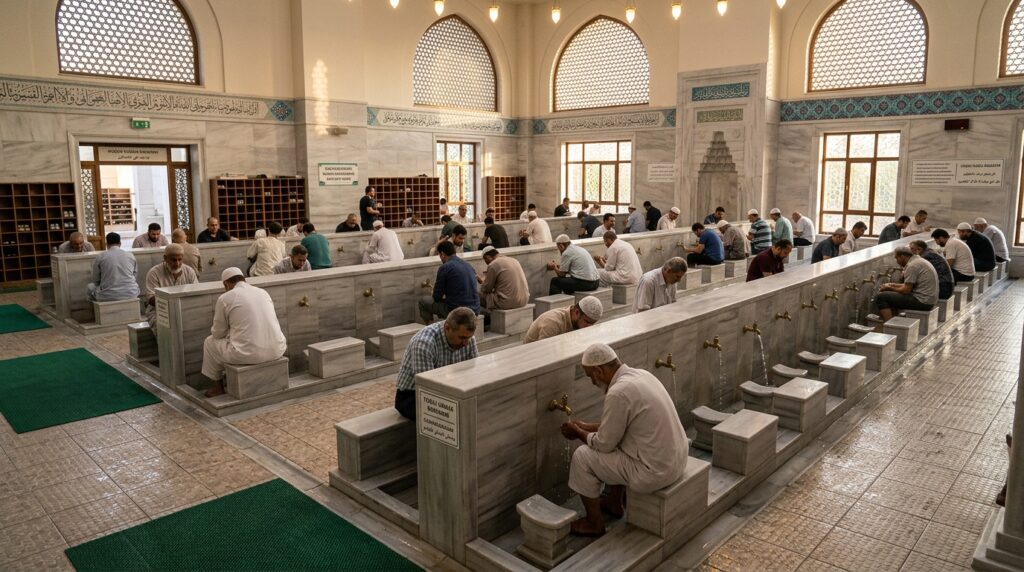
All over the world, when Muslims stand to pray Salah, there is one thing that is compulsory. And it is something they do before standing for Salah. I am talking about Wudu. Yes, if any Muslim brother or sister is reading this article, then they know that performing Wudu before Salah is obligatory. But for those who do not know what Wudu is, how to perform Wudu, and so on, this article will help them. Through Wudu, we keep ourselves clean, especially before Salah it is necessary that we stand in a pure and clean state. Along with that, Wudu is also a form of worship that Allah loves. In this article, my main focus is to teach the method of performing Wudu, which many people already know, but for those who do not know it, this article will be helpful. We will also talk about when Wudu becomes mandatory. Along with that, we will discuss the minor and major mistakes that break Wudu or mistakes because of which Wudu does not become valid. So today, we will learn all of these things in this article.
What Is Wudu?
Wudu is an act of worship that every Muslim performs. Most commonly, Wudu is performed before Salah, which is obligatory, meaning performing Wudu before Salah is compulsory. If a Muslim prays Salah without Wudu, then his Salah will not be accepted. If water is not available for Wudu, then you can perform Tayammum and pray Salah.
“O you who believe! When you stand up for prayer, wash your faces and your hands up to the elbows, wipe your heads, and wash your feet to the ankles.”
(Surah Al-Ma’idah 5:6)
Prophet Muhammad ﷺ said that Allah will not accept the Salah of the person who does not perform Wudu.
Wudu is compulsory before many acts of worship, such as Salah, voluntary prayers, Tawaf around the Kaaba, and touching the Mushaf (Quran). Even though the last point I discussed, touching the Mushaf, has been debated among scholars for years regarding whether Wudu is compulsory before touching it or not. Even though this debate has continued for years, the majority of scholars say that performing Wudu before touching the Mushaf is compulsory.
Conditions Before Performing Wudu
Before performing Wudu, there are a few conditions that you must fulfill so that your Wudu can become valid. The first condition is simple: the water should be clean. This means Wudu cannot be performed with dirty water. You can perform Wudu using tap water, lake water, well water, or rainwater.
The second condition is that you should not apply things on your skin that invalidate Wudu. As you know, when performing Wudu, it is necessary that the water properly covers your skin and reaches it correctly. But there are certain things such as creams or lotions that are water-resistant, because of which water does not reach the skin. In that case, your Wudu does not become valid. So it is better that if there is any such substance on your hands, feet, or face, such as paint or anything else, then first clean it properly with soap and water and then perform Wudu. That is better.
The third and very important condition. Many people may not know this, but having the correct intention before performing Wudu is very important. Yes, intention. This is an important step that is compulsory before Wudu. If you do not do it, then perform Wudu again with intention. This means you do not need to say it loudly. You can make the intention in your heart: “I am performing this Wudu for purification.” That is enough, and Inshallah your Wudu will be valid.
How To Perform Wudu?
Step 1: Bismillah
Basically, first you will make the intention and then begin Wudu by saying Bismillah.
Step 2: Wash Hands Three Times
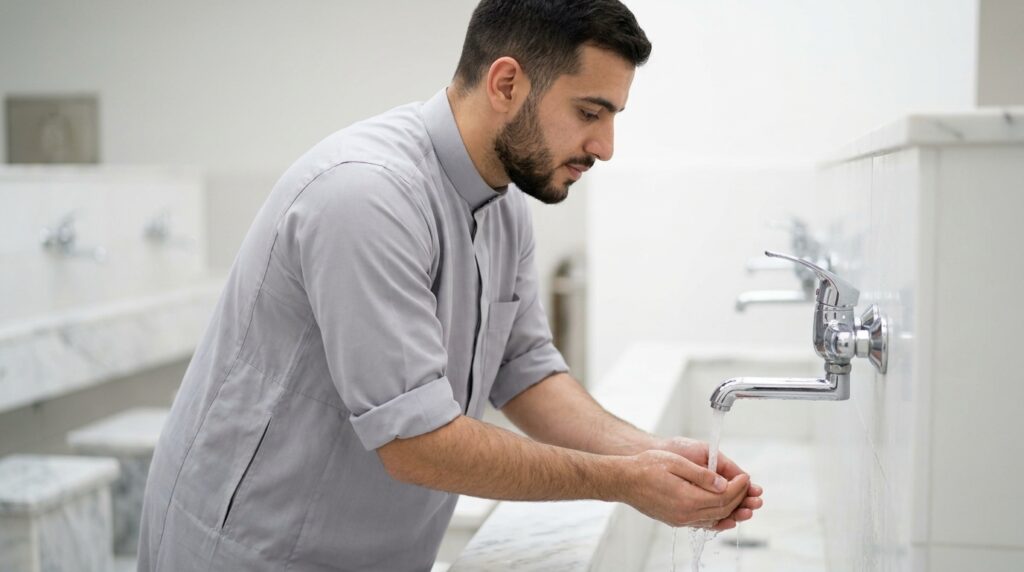
After saying Bismillah, wash your hands three times. Make sure your hands are properly cleaned with water and that water reaches between the fingers. Both hands should be properly washed up to the wrists.
Step 3: Rinse Mouth Three Times
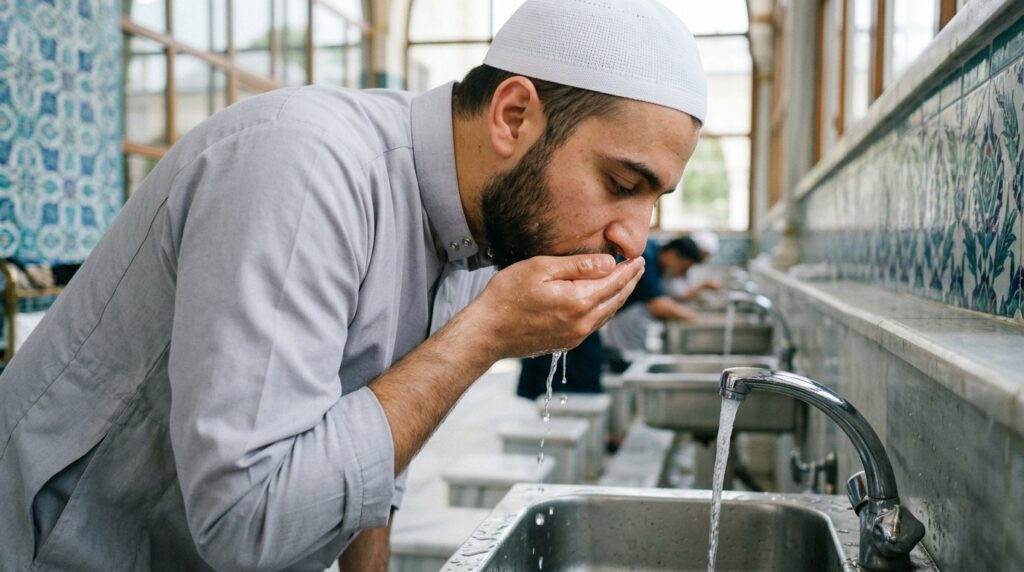
Then take water into your mouth, rinse it, and spit it out. You have to rinse your mouth with water three times. Take your time, do not rush, and rinse properly. You have to do this three times.
Step 4: Clean Nose Three Times
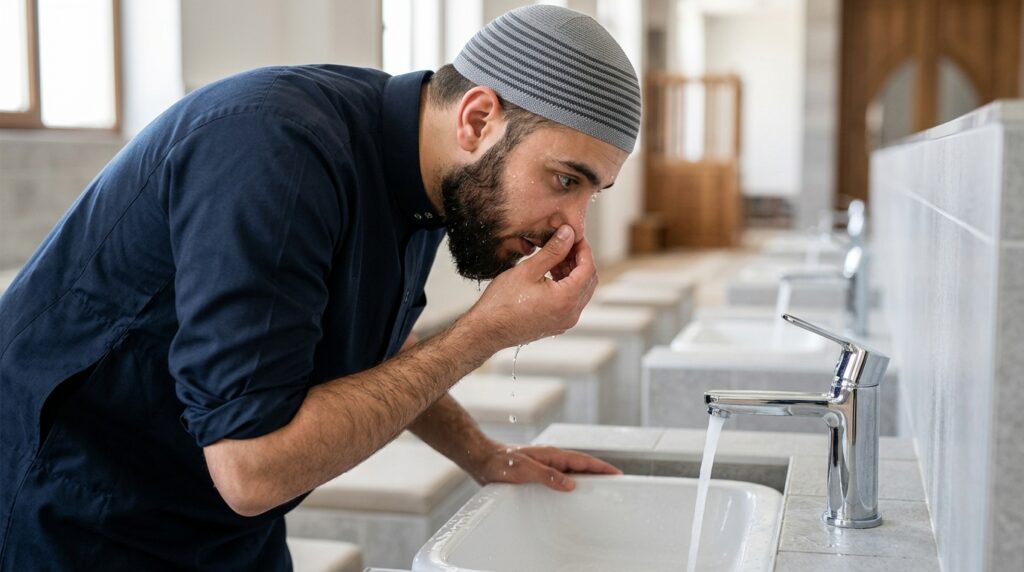
Now you have to clean your nose with water. Take a handful of water, bring it close to your nose, gently sniff a little water, and then expel it. Basically, you should not sniff too much water that it causes harm. Just do it gently and then expel it. You also have to do this three times.
Step 5: Wash Face
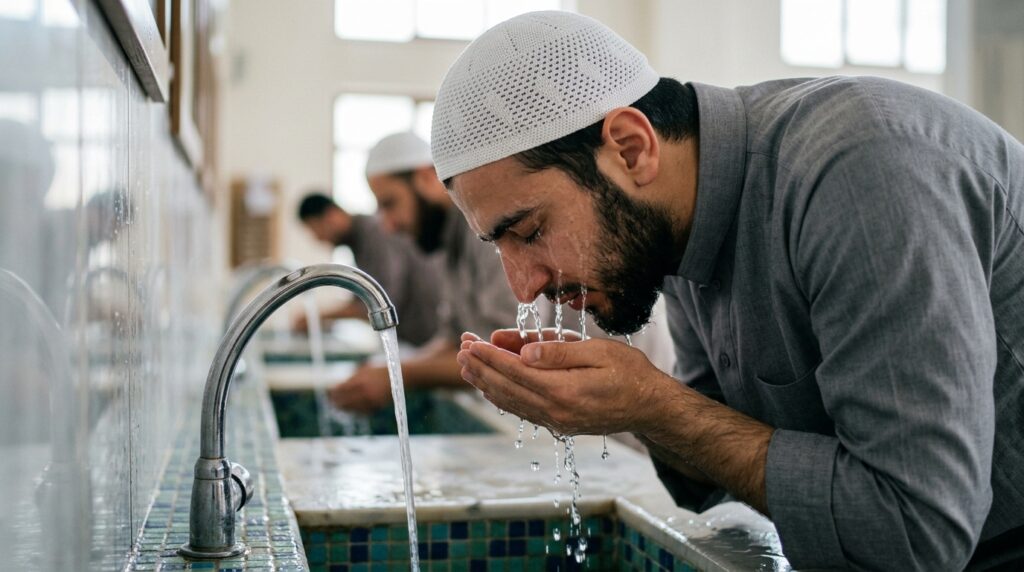
Now you have to wash your face. Make sure your entire face is properly washed, from the hairline to the chin. The complete face should be washed from ear to ear. Take water in both hands and wash your face. You also have to do this three times.
Step 6: Wash Arms
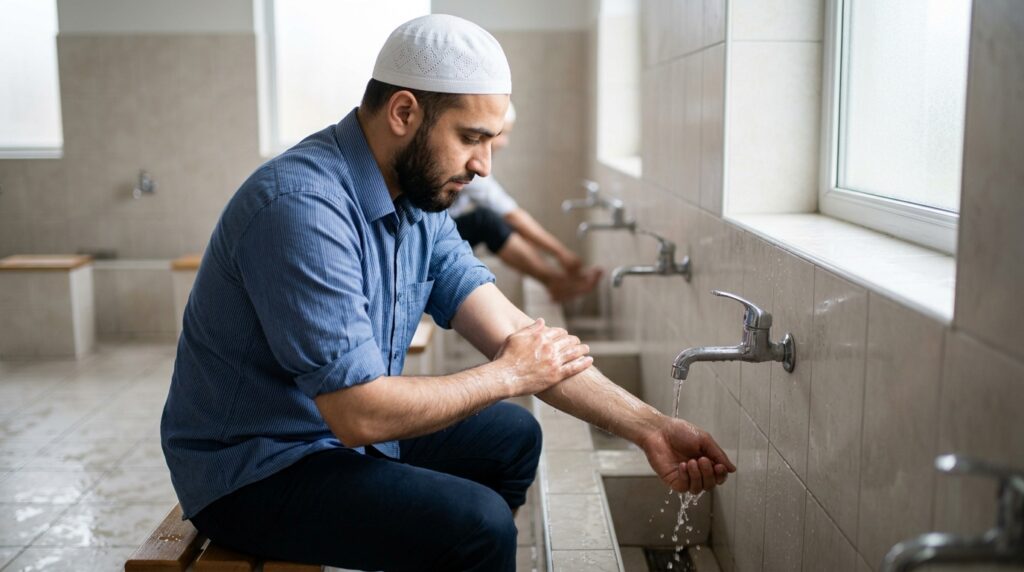
Now you have to completely wash your arms. The water should properly clean the entire arm. The elbows and everything should be covered with water so that the Wudu becomes valid properly. You also have to do this three times. Basically, wash the right arm with water up to the elbows three times, then repeat the same with the left arm three times.
Step 7: Wipe Head (Masah)

Now you have to wet your hands and perform Masah on your head, meaning wipe it. You have to move from the front hairline to the back of the head and then return to the front. This is done one time. You only need to wipe with wet hands, not wash the head. Just wiping is sufficient. Then wipe inside your ears properly with your fingers. Basically, the ears also need to be cleaned.
Step 8: Washing Feet
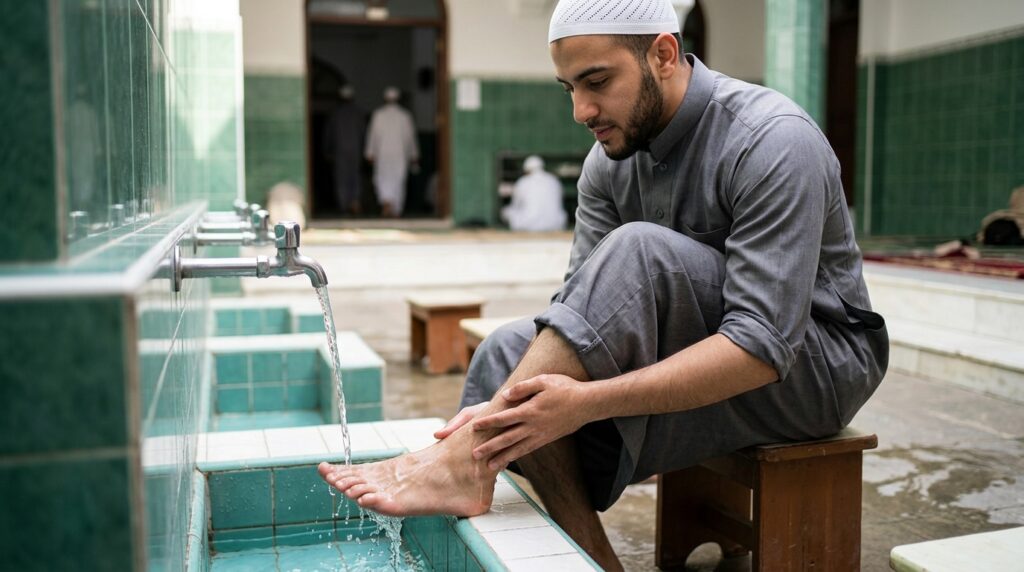
Now when everything is complete, you have to clean your feet with water. Make sure your ankles are properly cleaned with water and that water reaches between the toes as well. You have to wash them properly with water three times. Do not rush. Many people make mistakes in this step because they wash their feet too quickly and dry spots remain.
Step 9: Dua After Completing Wudu
أَشْهَدُ أَنْ لَا إِلٰهَ إِلَّا اللهُ وَحْدَهُ لَا شَرِيكَ لَهُ، وَأَشْهَدُ أَنَّ مُحَمَّدًا عَبْدُهُ وَرَسُولُهُ
“I bear witness that there is no deity except Allah alone without partner, and I bear witness that Muhammad is His servant and messenger.”
When your Wudu is complete, then recite this Dua. It is a powerful Dua and reciting it after Wudu is recommended. Prophet Muhammad ﷺ said that whoever recites this Dua after Wudu will receive immense rewards and all the gates of Jannah will be opened for him.
Keep in mind that Wudu should be performed in the same order that I explained above. Do not unnecessarily change the order.
How the Adhan Was Chosen in Islam: The Powerful Story Behind the Call to Prayer 2026
Why Friday Is So Special in Islam – Full History & Importance 2026
How To Pray Salah In Islam 2026: A Complete Step-by-Step Guide According To All Schools Of Thought
Difference Between Nabi and Rasool in Islam (Simple Explanation) 2026
The Rise and Fall of Al-Andalus: The Golden Age of Islamic Spain 2026
Common Mistakes
Some common mistakes that make your Wudu incomplete are not making the intention, rushing and leaving dry spots, not ensuring that water reaches properly up to the elbows, and not washing the ankles properly. These are some common mistakes that invalidate Wudu. Basically, if you work with proper intention and patience, then these common mistakes will not happen. If you perform Wudu calmly and patiently, then no dry spots will remain.
What Breaks Wudu
Now many people obviously know that there are some common things that break Wudu. Such as using the toilet. Urination, defecation, and passing gas break Wudu. Some other things that break Wudu are deep sleep and unconsciousness. There are also some matters regarding which scholars have different opinions, so you should research them more deeply, and when you understand the Madhhab, you will find the answer.
Conclusion
So this was the basic method of performing Wudu, and we also understood the common mistakes that make Wudu invalid. Wudu is not just a normal ritual, rather it is a great act of worship. Prophet Muhammad ﷺ said that major sins are forgiven through Wudu. Prophet Muhammad ﷺ also recommended that Muslims should remain in a state of Wudu at all times. Just like our great companion Bilal ibn Rabah رضي الله عنه, who used to remain in the state of Wudu all the time. So I hope you liked today’s article and learned something new today. That was it for today. We will meet again in our next article. Until then, take care of yourself and your family. May Allah forgive all our sins and accept our supplications. Ameen.
Great content! Keep up the good work!