

Table of Contents
Difference Between Nabi and Rasool
Today, we will talk about a very important and basic question whose answer many people might not know. Yes, we are talking about the difference between a Nabi and a Rasool. After all, what is the difference between them? People might think, “What is in this? Both are the same.” But it is not as you are thinking. Allah has used both the words Nabi and Rasool in the Quran. Therefore, there is a difference, but people do not know it. So today, in this article, we will understand the difference and what things make them different.
What Is The Difference Between a Nabi & a Rasool?
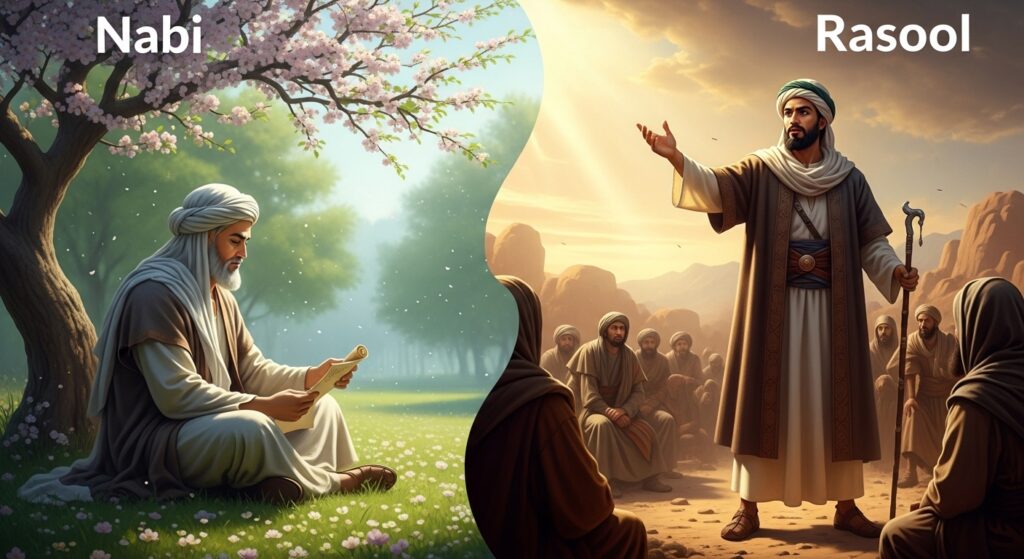
First, we will understand what the difference is between a Nabi and a Rasool, and we will also take some opinions from scholars and understand from their point of view. But to understand it broadly, I will tell you the important difference. First, keep in mind that (every Rasool is a Nabi, but every Nabi is not a Rasool). So, I won’t say there are certain qualities, but there is a mission that makes a Rasool and a Nabi different.
Every Rasool and every Nabi is chosen by Allah; He sends His revelation through Jibrael عليه السلام and sends Nabis and Rasools for the guidance of people so that they may recite Allah’s words to them. So, let’s start with the Nabi, and then we will learn about the Rasool.
Nabi
A Nabi is a prophet sent by Allah who comes for the leadership and guidance of people. As we all know, whether it is a Nabi or a Rasool, Allah speaks to them through revelation. So, a Nabi who is not a Rasool has the following role:
- Receives revelation from Allah.
- Follows and teaches the existing Sharia (law).
- Guides people within the community.
- They are divine.
- Do not bring completely new laws.
The work of a Nabi is only to follow the Rasools who have come before them and follow the Sharia law that was revealed to them from Allah. They are divine, they are prophets, and they do all the work that a Rasool does—for example, guiding people, etc. But as I said, they will follow the existing Sharia that was given to the Rasool before them, and no new Sharia law will be established. For example, Prophet Musa عليه السلام, who was a Rasool, received a revelation and a new Sharia law (Torah). All the Nabis who came after him—for example, Prophet Harun عليه السلام, etc.—would guide the people while following the teachings of Prophet Musa’s عليه السلام revelation (Torah) until another Rasool, like Prophet Dawood عليه السلام, was given the Zabur.
So this was about the Nabi. I hope you understand that a Nabi is also a prophet of Allah and has come for the guidance of people. But they will follow the teachings of the Rasool who came before them, and Allah will not reveal any new Sharia to them. The work of a Nabi is to remind people about Allah’s commands and reinforce existing teachings.
Rasool
On the other hand, we will talk about the Rasool. Those who are Rasools are also Nabis at the same time. Their work is also like a Nabi, but there is one difference, and that is a new Sharia law.
- Receives revelation from Allah.
- Receives a new Sharia law or major reform.
- Guides people within the community.
- They are divine.
- Is sent to people who may be in clear misguidance.
Rasools are Nabis sent by Allah, but another title is added to them: Rasool. Just like our Prophet Muhammad ﷺ is Rasoolallah. When they come, they establish a new Sharia law. Allah gives them a new Sharia law which they teach to the people. So, as I said, when Prophet Musa عليه السلام came, he brought a new Sharia law with him. All the Nabis who came after him followed that same law. But as soon as another Rasool comes, like Hazrat Dawood عليه السلام who was given the Zabur, then the Nabis coming after him, like Prophet Sulaiman عليه السلام (who is the son of Prophet Dawood عليه السلام), will follow the teachings of the Zabur and not the Torah.
- Also Read: Political Crisis After The Death Of Prophet Muhammad (PBUH) 2026
- Also Read: Waswasah in Islam: How Shaytan Misleads Through Doubts March 25, 2026
- Also Read: Watching Islamic Content In 2026 But No Change?
Scholarly Explanation About The Difference.
The points of view of some scholars are a bit different regarding the matter of Rasool and Nabi. Some scholars say that when a Rasool comes, he brings a new message with him. In English, a Rasool is also called a “Messenger” because he brings a message from Allah. And the Nabis follow the same message that the Rasool before them brought, and they teach it to the people. On the other hand, some scholars say:
“A Rasool is commanded to convey the message publicly. A Nabi may receive revelation but is not always required to deliver it in the same way.”
The wording is different, but both opinions support the same idea.
How Many Prophets & Messengers Were There?
The exact number is not available as to how many prophets and Nabis came into this world. But according to one Hadith, there were a total of 124,000 prophets whom Allah sent for the guidance of His servants. And among them, there were 300+ messengers, meaning Rasools. Still, we are not exactly sure about the number of all prophets or the exact number of how many messengers there were. So, Allah knows best.
Were There Any Female Prophets?
Now the question arises: did Allah send any female as a prophet? No. Many major scholars say that Allah did not send any female prophet. But on the other hand, a few minority scholars say that Hazrat Maryam عليه السلام was a prophet because Allah sent her revelation. Maryam عليه السلام is considered to be the greatest woman and a righteous servant of Allah. In the Quran, there is Surah Maryam, and Allah has mentioned Maryam’s name many times. But just because she was righteous does not mean she was a prophet. If she were truly a prophet, her importance in the Quran is very high and she is mentioned many times, yet Allah never mentioned Maryam as a prophet in the Quran. Nor has Prophet Muhammad ﷺ ever mentioned in any Hadith that Maryam was a prophet. So, this debate has been going on for years. Those who claim this do not have any solid proof that Maryam or any other woman is a prophet. Therefore, without any evidence, accepting it as true that Allah sent a female prophet is a sin.
Why Different Nabi & Rasool? Why Not Just One Type?
Now a question must be coming to your mind: why did Allah send two types of prophets—one Nabi and the other Rasool? Why not just one? The answer is simple. One is the Messenger who makes major changes with a new message, new law, etc. The other is the Nabi who guides people using those teachings. Not every situation required a Messenger. Sometimes people needed a reminder and reinforcement of the connection, so Allah would send a Nabi who would bring the people back on track. But whenever major changes happened, like a new Sharia, etc., Allah would send a Messenger. Keep in mind that a Messenger is also a Nabi, but every Nabi is not a Messenger.
Five Greatest Prophets Of Allah
Among the 124,000 prophets, there are five prophets who are very great and hold a high status. They are also called Ulul Azm.
- Prophet Nuh عليه السلام
- Prophet Ibrahim عليه السلام
- Prophet Musa عليه السلام
- Prophet Isa عليه السلام
- Prophet Muhammad ﷺ
These are the five prophets who have a great status. This is because they had a very big impact on the world and they went through extreme trials. Now, I have seen many people comparing prophets and saying, “This prophet is ours, we have nothing to do with that prophet, that prophet is for their group of people,” etc. I just want to say that all prophets are Allah’s best creations. So, making distinctions among prophets is not a right thing. Allah has clearly said that He does not make any distinction among His Nabis and Rasools.
“The Messenger believes in what has been revealed to him from his Lord, and so do the believers. Each one of them believes in Allah, His angels, His books, and His messengers. We make no distinction between any of His messengers.” (Surah Baqarah, Verse 285)
Allah has distinguished among the prophets in terms of rank, status, and divinity, but we should respect all prophets, and our faith will be valid only if we believe in all prophets. Otherwise, if you do not believe in even one of Allah’s prophets, your faith is not valid.
Conclusion
So this was the difference between Nabi and Rasool. I hope you now know that what you previously thought—that Nabi and Rasool are both the same—is not the case. There is a difference between these two words, so it is obvious that there is also a difference in their work. Allah sends a Rasool with a new message. On the other hand, a Nabi follows that same message and guides the people. And today your doubt has also been cleared as to whether Allah sent female prophets or not. Because as I said, a minority says that Maryam was a prophet, but they have no solid proof. So if she was truly such an important woman in Islam, and if she was truly a prophet, then why did Allah not mention her as a prophet in the Quran? Or why did Prophet Muhammad ﷺ not mention her as a prophet? It is not written anywhere in the Hadith that Maryam was a prophet. And today you also learned that distinction should not be made among prophets. No prophet should be lowered. All prophets are Allah’s best creation. Regarding their status and rank, Allah Himself has said in the Quran that the status and rank of some prophets are higher than other prophets. There is no sin in this. But respect is a must for all prophets.
That is all for today. We will meet again with a new topic. Take care of yourself and your family. May Allah forgive all our sins and accept our supplications. Ameen.
Hello to all, the contents existing at this website are actually awesome for people knowledge, well, keep up the nice work fellows.